



KlaritiQKlaritiQ
The KlaritiQ Blog

Rigorous thinking on AI, from the first model to the final audit.

Technology, governance and traceability, with benchmarks and practical playbooks for Indian companies, written by the team building KlaritiQ.

Latest from KlaritiQ

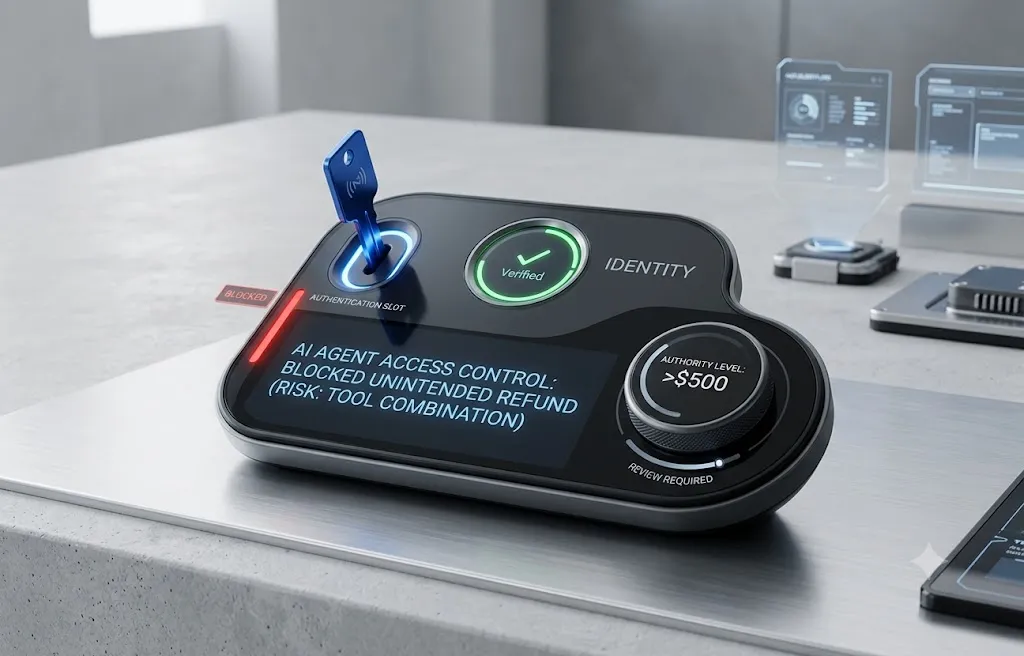
AI Agent Access Control: How to prevent excessive permissions and unintended actions

Approved tools can create unintended outcomes when combined. Map tool-to-tool workflows, constrain actions by task and risk, enforce independent controls, test failure scenarios, and reassess permissions whenever capabilities change.

15 Oct 2026Read →

AI agent security: what should organizations do when an agent takes an unintended action?

As AI agents gain access to enterprise systems, unexpected actions are becoming an operational risk. Salt Security’s research highlights gaps in traceability and containment. Organizations need to distinguish operational errors from control failures and security incidents, reconstruct events across systems, assess impact, assign corrective actions and verify outcomes. Detection alone is not ass

14 Oct 2026Read →

Internal Controls Testing: Can Your Controls Miss Failures and Still Pass?

Internal controls can pass testing while still missing failures if the tested sample is unrepresentative, parts of the population are excluded, or monitoring systems fail to capture relevant activity. Organizations need complete population records, automated exception detection, monitoring reconciliation and independent testing to verify that controls work as intended and gaps are investigated.

12 Oct 2026Read →

AI Decision Traceability: What You Need to Know About an AI Decision After It Happens

AI systems change constantly, but most governance records capture only what happened, not the exact system state behind a decision. This article explains why AI decision logging must connect decisions with model versions, data, configurations, dependencies, controls, and evidence, enabling organizations to reconstruct what their AI actually was when consequential decisions occurred.

8 Oct 2026Read →

AI Vendor Risk Management: What Happens When Your AI Vendor Changes the Model?

AI systems can change without internal deployments through model upgrades, vendor updates, data changes, APIs, dependencies, or permissions. The governance challenge is determining whether those external changes materially affect risk, existing approvals, ownership, and evidence. The enterprise ultimately remains accountable for continuing to operate the changed system. 

6 Oct 2026Read →

Your AI Has Git. Your Governance Doesn't.

AI systems have version control, but governance often doesn’t. Engineers can reconstruct exactly what changed, while governance may only show an old approval disconnected from the system that actually ran. The article argues for versioned, state-aware governance that links AI changes, approvals, evidence, and decisions over time.

5 Oct 2026Read →

Your Compliance System Says “Compliant.” Can You Prove It?

Having a written policy or a green "Compliant" dashboard does not mean your organization is actually compliant; the true test lies in whether you can readily prove how a control operated in practice

23 Sept 2026Read →

The AI Employee Nobody Put on the Org Chart

Your AI keeps changing after you approve it. Monitoring shows what changed, not whether that approval still holds. That gap is the real risk.

9 Sept 2026Read →

Point-in-Time vs Real-Time AI Assurance: Why Your AI Can Be “Compliant” and Still Be at Risk

Point-in-time assurance tells you whether an AI system met requirements when it was assessed. Real-time monitoring tells you what is changing as the system operates. Neither is enough alone. Modern AI assurance connects the two: detect what changed, understand its impact, make an accountable decision, take action, and preserve the evidence to prove what still holds.

2 Sept 2026Read →

Why AI Deployment is Only Half the Battle (And Why Static Governance Fails)

While 70% of organizations deploy AI, only 2% run it maturely. Live systems constantly change as datasets drift and models update. Static, point-in-time assessments cannot track these shifting conditions

19 Aug 2026Read →

Why KlaritiQ Exists: Building the Future of Continuous AI Assurance

KlaritiQ is a Continuous AI Assurance platform that helps organizations know what is true at any moment. By continuously governing evidence, policies, controls, vendors, AI initiatives, and organizational dependencies, KlaritiQ produces defensible assurance that enables leaders to make decisions based on verified reality rather than assumptions.

3 Aug 2026Read →

The Examiner Who Never Sleeps: Why Annual Audits Are Just Security Theater

Annual audits create a 363-day blind spot where hidden compliance risks accumulate. Under regulations like India's DPDP Rules 2025, continuous AI governance replaces staged, once-a-year "security theater" with real-time, automated protection.

27 Jul 2026Read →

The Keystroke That Destroys Your Compliance: Are You Governing or Just Excavating?

A mistake takes 3 seconds. Your review process takes 3 weeks. By the time you spot the breach, the damage is already done and the bill is in the mail.

21 Jul 2026Read →

The Form Is an Apology: Why Enterprise Questionnaires Are Obsolete

Every compliance questionnaire is a workaround for a machine that couldn't read. The machine can read now. Learn why evidence-based verification is replacing self-reported risk assessments under DPDP.

20 Jul 2026Read →

The Pilot Paradox: Why 80% of Mid-Market AI Initiatives Stall After the Demo

Most corporate AI pilots stall when they encounter the three pillars of operational deployment: data lineage, cross-functional accountability, and governance (DPDP). The bottleneck is no longer capability; it’s operational discipline. Learn how to br

15 Jul 2026Read →

AI Readiness Assessment: The Complete Enterprise Guide (2026)

Learn how to measure your organization's AI readiness across strategy, people, data, infrastructure, and governance. Includes a free AI Readiness checklist and enterprise framework.

10 Jul 2026Read →

The Anatomy of a 45-Hour Migration: Consolidating Departmental Chaos Into One Hub

Stop automating chaos. Migrating messy data into a new platform just builds an expensive version of legacy debt. To win, spend 10h on architecture, 20h on config, and 15h testing. Map first, build second.

3 Jul 2026Read →

The Process Debt Trap: Why New Software Can’t Fix Broken Workflows

Most digital transformations fail because of broken processes, not bad software. Technology only accelerates existing workflows, so automating inefficiency creates faster chaos. Map and simplify your processes first, then configure the software.

2 Jul 2026Read →

Why your Enterprise AI stalls at the Database: The hidden lineage crisis in Indian tech architecture

70% of Indian AI projects stall. It's not your prompts, your models, or your tech team. The real culprit is a hidden, multi-core "data lineage crisis" rotting inside your legacy architecture.

26 Jun 2026Read →

The AI skills gap in India: it's not about Coding

Indians fear AI will replace them. But the real gap isn't technical it's leadership, judgment, and understanding. Here's what actually matters.

25 Jun 2026Read →

While Europe builds rulebooks, India is building runways

The winners of the AI decade won't be the companies with the biggest models. They'll be the countries that let builders move fast without abandoning trust. Because speed without trust creates hype, but trust creates empires.

23 Jun 2026Read →

The ₹250 Crore AI Mistake Most Indian Companies Won't Discover Until It's Too Late

DPDP Act means compliance is no longer a legal afterthought; it's the absolute foundation of your architecture. If your data isn't clean enough to satisfy regulatory parameters, it's too weak to power an AI model.

22 Jun 2026Read →

Why AI Adoption Fails? (And How to Fix It)

70% of corporate AI projects collapse into expensive, silent failures. But studying why they die reveals an uncomfortable truth: the breakdown isn't caused by the complexity of the technology, but by the cracks in our own human alignment.

21 Jun 2026Read →
Featured
10-minute read · Benchmarks

India's MSME digital maturity sits at 58 out of 100.
Here's what that actually means.

Published India research, the MSME Digital Maturity Index (Vi Business, 2025) and CII-KPMG's manufacturing data, tells a consistent story: maturity is early-stage but rising, and the gap between AI ambition and execution is wide enough to matter.

AT
KlaritiQ Team
Research & Insights
June 10, 2026
10 min read
India Avg · ARI Score
64
Contender
Strategy
72
People
60
Data
58
Infra
55
Gov
38
All articles
🧠
People & Literacy

Your AI strategy will fail without this one hire first

An internal AI champion is the most reliable predictor of adoption in Indian mid-market firms, more than budget or headcount. Here's the job description you actually need.

June 5, 2026 · 7 min
→
🗄️
Data Foundations

Why "we have data" is not the same as "we're data-ready for AI"

Indian companies consistently overestimate their data readiness. Here are the four failure modes that block AI value, and how to fix them in 30 days.

May 28, 2026 · 8 min
→
⚖️
Governance

India's AI governance gap is a business risk, not just an ethics issue

With DPDP Act implementation underway, governance is suddenly not optional. Companies scoring below 50 on ARI's governance dimension face concrete compliance exposure. Here's what to build first.

May 20, 2026 · 9 min
→

New posts, straight to your inbox.

Real numbers from real assessments, how Indian companies are moving on AI maturity, which industries are accelerating, and what the top 10% are doing differently. We email you the moment a new post goes up, nothing more.

58
India MSME maturity · Vi Business 2025
Benchmarks

Where India actually stands on AI readiness, and the gap that defines 2026.

AT
KlaritiQ Team
Research & Insights
June 10, 2026
10 min read

When we built KlaritiQ, we started from a hypothesis: most Indian companies believe they are further along on AI than they actually are. The published research backs it up, with one important nuance. (For how we turn that into a single comparable number, see how the AI Readiness Index is calculated.)

India's MSME Digital Maturity Index sits at about 58 out of 100 (Vi Business, 2025), and only 12% of MSMEs reach full digital maturity. For mid-size manufacturers specifically, CII-KPMG puts maturity at 2.9 out of 5, early-stage but real. Not laggards, but not leaders either.

What "early-stage but real" looks like

It usually means a company has done several things right: leadership has named AI a priority, a pilot or two is running, someone owns a roadmap on paper. The gap is rarely ambition, it's execution.

The defining pattern of 2026 is the intent-execution gap. Surveys show roughly 94% of firms recognise AI's value and around 72% plan to increase cloud spend, yet only about 28% of manufacturers had reached meaningful AI adoption by FY24 (TeamLease). Intent is rising faster than execution.

Companies are building on a foundation they haven't finished constructing, making AI announcements while data quality and governance go unaddressed beneath the surface.

Where the real gaps are

58
National MSME maturity (/100)
Vi Business, 2025
2.9
Mid-size mfg maturity (/5)
CII-KPMG
~28%
At meaningful AI adoption
by FY24 · TeamLease

Talent is the binding constraint. ML, data-science and architect roles run a 60–73% demand-supply gap in India, and a data scientist costs ₹12–28 LPA fully loaded. For most mid-market firms, hiring a team for a first project is costly and high-risk, buying or renting capability beats building it.

Data is the under-counted bottleneck. Companies report having "a lot of data," but volume isn't readiness. Data preparation alone is 30–60% of an AI project's cost, the single most under-budgeted line item.

Build-vs-buy is where budgets are won or lost. Purchased or partnered AI tools succeed roughly 67% of the time; first-time internal builds succeed about a third as often (~22%, per NANDA, research with varying success definitions). Moving a custom build from proof-of-concept to production raises cost 250–400%.

Governance is the most urgent gap. With the DPDP Rules gazetted in November 2025 and core obligations enforceable from May 2027, 2026 is a build year, not a grace period. Using existing personal data for a new AI purpose requires fresh consent, and liability stays with you even when the AI is an outsourced tool.

What separates the movers from the stuck

Three moves consistently mark the firms that pull ahead:

  1. Name an owner. A single accountable person for AI, policy, data, and a first use case, beats a committee. Enthusiasm without a mandate stalls.
  2. Fix data before models. Audit the data behind your top use case first. Most stalled initiatives are blocked by data problems, not model problems, and data prep is where the cost hides.
  3. Buy or rent your first win. At this scale, off-the-shelf SaaS or a managed API gets you a working result faster and cheaper than building, and lets you prove value before committing.

Want to see where your company sits? The full ARI assessment is one sitting, under 8 minutes, and gives you a tier for every dimension, the weakest one named, and a concrete 90-day plan.

🧠
People & Literacy

Your AI strategy will fail without this one hire first

AT
KlaritiQ Team
Research & Insights
June 5, 2026
7 min read

One variable predicts AI success in Indian mid-market firms more reliably than budget, headcount, or the number of AI tools deployed: the presence, or absence, of a dedicated internal AI champion.

It's a pattern that repeats. The firms that move have a named, empowered champion driving adoption; the ones that stall have enthusiasm spread across a committee and owned by no one. Against a talent market where ML and data-science roles run a 60–73% demand-supply gap, an internal owner who can direct AI, rather than an expensive new specialist hire, is often the difference between a pilot that ships and one that quietly dies.

What an AI champion actually does

This isn't a data scientist. It's not the CTO doubling as "the AI person." It's a dedicated operator, someone whose explicit job is to drive AI adoption across the organization, not ship models.

  1. They speak both languages, engineering and business, without code-switching between teams.
  2. They run toward the messy organizational problems rather than deferring to later.
  3. They can identify a 90-day quick win, execute it, and tell the story in a board meeting.
  4. They have a personal conviction about AI that isn't easily eroded by setbacks or skeptics.

The job description you actually need

Title: Head of AI Enablement (or VP of AI / Director of AI Transformation)

Reports to: CEO or COO (not CTO, this role is cross-functional, not an engineering sub-team)

Success metric at 90 days: One production AI deployment that non-technical stakeholders can point to, explain, and measure.

What they're responsible for: Identifying high-value AI use cases across departments. Running the internal AI literacy program. Coordinating between data, engineering, legal, and business units. Tracking the company's ARI score over time.

What they are not responsible for: Building models. Managing the data platform. Generating R&D output. Those are engineering functions. Mixing them with the champion role is how organizations burn out good people.

If you can't hire yet, name someone

Early-stage companies often can't make a full-time hire immediately. The fallback isn't to leave the chair empty, it's to formally name an existing team member as the AI champion, with 20–30% of their time and explicit mandate. Our data shows that even a part-time champion, with real authority, produces measurable ARI improvement within one quarter.

Curious how your team scores on the People & Literacy dimension, and what your biggest gaps look like? Run the KlaritiQ assessment and get a dimension-by-dimension breakdown in a single sitting.

🗄️
Data Foundations

Why "we have data" is not the same as "we're data-ready for AI"

AT
KlaritiQ Team
Research & Insights
May 28, 2026
8 min read

The most common thing founders and CTOs say when we start a KlaritiQ assessment: "Our data situation is pretty good, we've been collecting it for years." And then the Data Foundations dimension scores come back, and the conversation changes.

Across Indian mid-market firms, the bottleneck is data readiness, not data volume. Companies have enormous datasets; what they lack is data that's owned, clean, and accessible to a model. Volume and readiness are completely different things, and the gap is expensive: data preparation alone runs 30–60% of an AI project's cost, the single most under-budgeted line item.

The four failure modes we see in every assessment

1. No data ownership

Data that "belongs to everyone" belongs to no one. Without a named owner for each key data domain, there are no quality standards, no update cadences, and no one to call when an ML model starts behaving strangely because its training data drifted.

2. No data lineage

Can your team answer: "Where did this column come from, and what transformations has it been through?" If not, you can't trust what you'd use to train a model. Lineage is the chain of custody for data.

3. Siloed systems that can't talk

The data is in three CRMs, two data warehouses, an old MySQL database from 2019, and three different BI tools. Each team's definition of "a customer" is slightly different. This isn't a ML problem, it's a data architecture problem that blocks ML entirely.

The optimism is understandable, and usually misplaced. When you probe the specifics, ownership, lineage, quality gates, accessibility, most companies that rate their data as "good" have at least two of these four failure modes present. The same pattern shows up in enterprise software, where roughly 75% of ERP implementations get derailed, and the root causes are organisational, not technical. The gap is solvable, but only once it's visible.

4. No quality gates in the data pipeline

Data enters the system and nothing validates it. Duplicate records, null values in critical fields, schema drift from upstream API changes, these compound silently until they surface as a model that starts making confidently wrong predictions.

The 30-day fix that changes the trajectory

  1. Pick one use case. Identify its three core data inputs. Don't generalize. What data, specifically, would this model consume?
  2. Run a data quality audit on those three inputs. Completeness, accuracy, consistency, timeliness. Measure it. Quantify the gaps.
  3. Assign an owner to each data domain. One person. Accountable. In writing.
  4. Add one quality gate to the pipeline. A dbt test, a Great Expectations check, an anomaly alert in your warehouse. One gate, running in production, before you train anything.

Get a precise score on your Data Foundations dimension, plus a prioritized plan to close the gaps before they block your AI roadmap.

⚖️
Governance

India's AI governance gap is a business risk, not just an ethics issue

AT
KlaritiQ Team
Research & Insights
May 20, 2026
9 min read

When governance comes up in an AI readiness conversation, the default reaction from founders and product teams is a kind of respectful dismissal. "Yes, we'll get to that." In 2026, that posture is a business risk.

The numbers

Nov 2025
DPDP Rules gazetted
the build year has started
May 2027
Core obligations enforceable
possibly Nov 2026 if accelerated
100%
of liability stays with you
even when AI is outsourced

Three concrete risks that land on your P&L

1. DPDP Act compliance

India's Digital Personal Data Protection Act is not a future consideration. AI systems that process personal data require data principal consent frameworks, breach notification protocols, and data fiduciary obligations. Companies without governance infrastructure aren't just ethically exposed; they're non-compliant.

2. Enterprise customer requirements

If your company sells to mid-market or enterprise customers, AI governance questionnaires are now standard in vendor security reviews. Customers are asking: Do you have an AI usage policy? Do you conduct bias audits? Without answers, deals stall or don't close.

3. Model failure liability

When an AI system makes a consequential error, the question immediately becomes: what oversight was in place? Companies with governance frameworks have an answer. Companies without one have exposure.

What to build first (the minimum viable governance stack)

You don't need a 40-page AI ethics charter to close the gap. You need three artifacts that can be written in one intensive week: a responsible AI policy, a model risk assessment template, and an AI inventory.

The Responsible AI Policy (2–4 pages): What AI systems are you building or using? What decisions do they inform? What are the prohibited use cases? Who reviews AI systems before deployment?

The Model Risk Assessment Template (1 page per model): What data does this model use? What's the failure mode? Who monitors it in production? When was it last audited?

The AI Inventory (spreadsheet is fine): A list of every AI tool or model in use across the company, including the third-party SaaS tools with embedded AI features that most companies forget about entirely.

The 90-day governance sprint

A focused 90-day governance sprint, write the policy, complete the inventory, run one model risk assessment, is enough to move a firm from improvising compliance on every project to a defensible baseline. And for an ordinary mid-market manufacturer, the heaviest obligations (like algorithmic due diligence, which bites only on notified significant data fiduciaries) don't even apply yet. That's exactly why the build year is the cheap time to act.

See your governance score specifically, and get a prioritized action plan that targets your weakest governance gaps first.

The KlaritiQ Blog· 8 Oct 2026

AI Decision Traceability: What You Need to Know About an AI Decision After It Happens

There is a question that sounds simple until someone actually asks it during an audit: “What exactly was your AI when that decision happened?”

Imagine an NBFC reviewing a customer complaint from six months ago. The customer is disputing an AI-assisted decision that affected how the case was handled. The compliance team wants to understand what happened, so someone pulls the application logs. The timestamp is there. The customer record is there. The output is there. The model name is there. Everyone initially feels reassured. Then someone asks a more specific question: 

Was that the same model that is running today?
No. The model provider upgraded the underlying model three months ago. The retrieval index has been refreshed several times since the decision. The policy document used by the retrieval system has also changed. The prompt has been modified once. The current configuration is properly documented, but nobody preserved the complete configuration that existed on the day the decision was made. The organization can prove that the AI made the decision. It may not be able to prove what the AI actually was when it made it.

That distinction is becoming one of the more important problems in AI governance.

An audit trail is not automatically a history of the AI

Most enterprises already have logs. Applications generate them, cloud platforms generate them, databases generate them, security systems generate them and vendors often provide their own activity records. So why is reconstructing an old AI decision still difficult?

Because a timestamped event and a timestamped system state are not the same thing. Suppose an AI system produces a recommendation at 11:32 AM on 14 March. The event log might tell you that the recommendation happened at 11:32 AM. It might identify the user, the application and the model endpoint. But the decision itself could have depended on a much larger environment: the model version, system instructions, retrieval sources, data available to the model, business rules, external APIs, permissions, safety layers and other dependencies.

If those components continue changing after 14 March, looking at the current system does not reconstruct the system that existed on 14 March. 

This is where AI creates a subtle problem for traditional audit thinking. We are used to treating an application as something that can be inspected today and compared against historical records. But AI systems increasingly depend on components outside the application's own deployment boundary. NIST's 2026 research on monitoring deployed AI systems specifically identifies fragmented logging across distributed infrastructure, difficulty detecting degradation and drift, and the challenge of monitoring AI systems as they scale as open problems.

The result is an uncomfortable possibility: you can have plenty of logs and still have an incomplete audit trail.

Consider what happens after the decision

Go back to the NBFC example. On 14 March, the AI evaluates a customer complaint and classifies it as requiring manual escalation. The organization has an approval for the AI system. Its risk assessment says the system is permitted to assist with this particular workflow. The team is comfortable with the model's limitations and has documented the relevant controls.

Then April arrives. The vendor upgrades the underlying model. In May, the retrieval system receives a large batch of revised internal policies. In June, the prompt is changed to improve response consistency. In July, a new internal data source is connected to the workflow. Now it is September, and an auditor asks about the March decision.

The team can show what the system looks like in September. It can show that the March decision happened. It can show that the system had been approved. But unless those records were connected to the historical state of the system, there is a missing piece between them. The question is no longer simply 

“Did the AI make this decision?”
It becomes 

“What system made this decision, what information and controls shaped it, and what had actually been approved at that point in time?”
That is a much harder question. And importantly, it is not solved by simply taking more screenshots of the current dashboard.

This is where the story moves from logging to traceability

There are really three different histories an organization needs to keep connected.
  1. The first is the decision history: what happened, when it happened, what output was produced and what action followed.
  2. The second is the system history: what model, prompt, data, configuration, dependencies, permissions and other relevant components were active when the decision occurred.
  3. The third is the governance history: what had been assessed, what had been approved, which controls applied, who was accountable and what evidence supported that conclusion.

The problem appears when these three histories live in different places and are not connected. Your application log says the decision happened. Your model registry says Model X was deployed at some point. Your compliance folder contains an assessment. Your vendor portal contains release information. Your document management system contains the approved policy. Each record may be perfectly legitimate. Yet an auditor asking one historical question can expose the gap between them: 

Were all of these records describing the same AI at the same moment?
That is what makes AI auditability more difficult than simply retaining logs.

Knowing what changed is not enough

There is another important distinction here, and it came up in the discussion around our previous article. One governance professional who commented on our previous article "AI Vendor Risk Management: What Happens When Your AI Vendor Changes the Model?" made a particularly useful observation: transparency is only the starting point. Knowing what changed is not enough; organizations also need to understand what those changes could mean for the decisions their AI systems are making. Otherwise, governance can become a paper shield. 

That distinction matters here because an audit trail can tell you that a model changed without telling you whether that change affected a decision. Imagine a vendor announces that an underlying model has moved from Version A to Version B. The change is recorded. The notification is retained. The vendor documentation is available. That establishes the event.

It does not answer whether the organization's previous evaluation still applies. 

Did the model's capabilities change in a way relevant to the use case? Did its known limitations change? Did the previous testing cover the new model? Did a control depend on behavior that no longer exists? Did the change affect a system that makes consequential decisions? Did the organization's risk assessment need to be revisited? 

Those are enterprise questions, not vendor questions.

NIST's AI Risk Management Framework makes this distinction explicit in its treatment of third-party AI resources and post-deployment management. It calls for third-party AI risks to be regularly monitored and documented, while post-deployment monitoring should include mechanisms for change management and ongoing evaluation. So the objective is not to create a larger pile of notifications. The objective is to connect 

Change → Impact → Decision → Evidence.

That is where an audit trail becomes an assurance capability.

The model version is only one piece of the puzzle

A common response to this problem is to say, “Fine. We will record the model version for every decision.” That is a good start. It is not the complete answer.

Consider a customer-service AI using a foundation model together with a retrieval system containing internal policies. The underlying model does not change at all. The organization updates the policy repository, and the retrieval system begins returning a different set of documents for similar questions. The model is identical but the system may not be. The same problem can appear when a prompt changes, when a tool becomes available to an agent, when a permission expands, when an external API changes its behavior, when a dataset is refreshed or when a vendor-controlled component changes underneath the application.

This is especially important as AI systems become more agentic. An AI agent is not defined only by the model behind it. Its capabilities also depend on the tools it can access, the systems it can interact with, the information it can retrieve and the permissions it receives.

So asking “Which model did we approve?” may be insufficient. A more useful historical question is:

“What could this AI access, what information could it use, what instructions governed it and what decisions was it authorized to influence when this event occurred?”
That is the system you need to be able to reconstruct.

The dangerous assumption is that someone will reconstruct it later

This is where many governance programmes quietly depend on hope. The organization keeps its current documentation. It retains some logs. It has vendor contracts. It has approval records. It has a model inventory. If there is ever an incident, someone will investigate and piece everything together. That sounds reasonable until the investigation actually happens six months later.

The engineer who configured the system has moved teams. The vendor has retired the previous model. The retrieval index has been rebuilt. The old configuration has been overwritten. The policy document has been replaced. Some application logs have expired. The approval exists, but the evidence supporting it was stored somewhere else. Nobody necessarily did anything wrong.

The organization simply never designed the governance system to preserve the relationship between the decision and the state of the AI at that moment. The investigation then becomes archaeology. 

And archaeology is not assurance.

Regulators are moving toward historical traceability for a reason

This is not merely an academic concern. The EU AI Act provides a useful illustration of where AI governance is heading. Article 12 requires high-risk AI systems to technically support automatic recording of events over the lifetime of the system, with logging capabilities intended to support traceability of system functioning, risk identification and post-market monitoring. The regulation also requires relevant logs to be retained under specified conditions.

The underlying principle is important beyond the precise scope of the regulation:

When an AI system has meaningful consequences, its history becomes part of the evidence required to understand and govern it.
India's financial sector is moving through a similar conversation from a different regulatory starting point. RBI has highlighted the importance of responsible AI adoption alongside concerns around explainability, accountability, transparency and data privacy in financial services. 

For an Indian enterprise, particularly one using AI in lending, fraud detection, customer operations, underwriting or other consequential workflows, this creates a practical question: if someone challenges a decision later, can the organization reconstruct the conditions under which that decision was produced? That question becomes increasingly difficult as AI dependencies become more dynamic.

Continuous assurance is not “checking compliance every day”

This is also where the meaning of continuous compliance needs to be understood correctly. Continuous assurance does not mean forcing a compliance team to review every model change, data refresh or configuration update every morning. That would create an enormous amount of activity without necessarily producing better governance.

The point is to distinguish ordinary change from material change and connect material change to the systems, decisions and controls it could affect. If a vendor changes a model, the organization should be able to identify which AI systems depend on it. If a policy changes, it should be possible to identify which AI workflows rely on that policy. If a permission changes, the organization should know which AI systems gained a new capability. If an important AI decision occurred before any of those changes, the organization should be able to preserve the state that existed when the decision happened.

This is the difference between monitoring the present and maintaining assurance across the lifecycle.
NIST's AI RMF similarly treats post-deployment monitoring as an ongoing activity involving system performance, trustworthiness, changes, incidents and third-party resources rather than a one-time assessment performed before deployment. The governance trigger therefore cannot simply be “a deployment happened.”

Sometimes there is no deployment. Sometimes the important event is that something around the AI changed. And sometimes the most important event is that someone made a consequential decision while that system was in a particular state.

Start with one decision, not the entire AI estate

There is a practical way to test whether an organization actually has this capability. Do not begin by asking whether every AI system has perfect traceability. Pick one consequential decision from six months ago. Take a credit recommendation, fraud alert, customer escalation, claims classification or an AI-assisted operational decision. Then work backwards.

Can you identify the exact time of the decision? Can you identify the system that produced it? Can you establish which model and relevant configuration were active? Can you identify the information sources available to the system? Can you establish which external dependencies and permissions were in place? Can you identify the controls and governance decision that applied? Can you show the evidence that supported that approval? Can you distinguish what was true before the decision from what changed afterwards?

If the answer to all of those questions is yes, you have something valuable. If the answer is “we can probably find most of it,” you have a different problem.

And if the answer depends on asking three different teams to search five different systems, you have discovered exactly why continuous assurance needs to become an operating capability rather than a collection of documents.

The question changes from “Is it compliant?” to “Was it defensible?”

This is the mental shift that matters. Traditional compliance tends to produce a snapshot: 

The system was assessed, the controls were documented and the organization concluded that the system met the applicable requirements.
That snapshot has value. But AI systems continue moving after the snapshot. Models change. Vendors change. Data changes. Prompts change. Permissions change. Dependencies change. Business processes change. The people responsible for the system change. So a stronger question is not simply: “Is this AI compliant today?” It is:
“When this important decision happened, was the AI operating within the conditions we had assessed and approved, and can we prove it?”
The second question forces governance to connect the present with the past. It also changes what evidence means. Evidence is no longer simply something you upload before an assessment. It becomes part of the historical record of how the AI was operating, what changed around it, what decisions were made and why the organization concluded that those decisions remained acceptable. That is the foundation of continuous AI assurance.

Your AI should have a history you can defend

The real test of AI governance may not happen when everything is working perfectly. It may happen six months later, when somebody asks about a decision that nobody remembers making. At that moment, the organization should not have to reconstruct the story from fragments. It should be able to move backwards from the decision to the AI state, from the AI state to the evidence, and from the evidence to the governance conclusion.

That means being able to say: this was the system, this was the context, these were the dependencies, this was the applicable governance decision, this is what changed afterwards, and this is why the organization believes the decision was valid at the time. That is a much stronger standard than simply having logs.

Our previous article, "Your AI Has Git. Your Governance Doesn't.", looked at the first part of this problem: whether governance can reconstruct the system state it approved. The following article on "AI Vendor Risk Management" looked at what happens when that state can change outside the organization's own deployment process. The next question is what happens when an important decision has already occurred. 

Because knowing that your AI changed is useful. Knowing what the AI looked like when it made the decision is better. Being able to prove what was true, understand what changed, determine whether it mattered and preserve the reasoning behind the decision is assurance. That is where AI governance stops being a folder of approvals and starts becoming an operating capability.

KlaritiQ is built around this gap: connecting AI system state, changes, dependencies, governance decisions, ownership and evidence so organizations can continuously determine not only what their AI looks like now, but what was true when it mattered.

What did you think?

Discussion (0)

Comments from visitors are reviewed before they appear. Sign in to comment right away.

No comments yet. Be the first to share a thought.

See where your company's audit readiness actually stands.

Get my free audit readiness assessment